

Genuine self-love is essential for good wellbeing, no matter who you are or how you identify. When you don’t feel good about yourself, it’s hard to feel good about anything.
If you’re stuck in cycles of guilt and shame for feeling the way you feel right now, it’s probably affecting your self-esteem and self-worth. So let’s start here at the root of what’s eating away at you inside.
Signs that you need to increase your self-love often include one or more of these:
- Unable to let go of negative thoughts
- Generally feeling down, depressed, sad, angry or hopeless
- Obsessing over your appearance
- Struggling to speak up for yourself, or the opposite – being overly aggressive
- Feeling numb, empty, or disconnected
- Often feeling used, taken advantage of, or ignored
- Feeling lonely, even when you’re with other people
- Struggling to build or maintain relationships
- Unhealthy relationship with food
- Self-harm, disordered eating, or self-punishment
This page will help you explore:
- What is self-love in Islam? Facts vs feelings.
- Eight powerful tips to rebuild feelings of self-love and self-worth
What is self-love in Islam?
“…when I have proportioned him and breathed into him of My Spirit, fall down before him prostrating. Thereupon the angels bowed down, all of them together. Save Iblis…” – Qur’an 15:29-31
Do you know that you, yourself, are among the most wondrous treasures of creation? When Allah created the first human being, Allah ordered all the angels to bow down to this new creation. Why? Because Allah ‘breathed His spirit’ into Adam, (Qur’an 15:29).
Whether we think of this metaphorically or literally, most Muslims understand it to mean that Divine qualities flow through our life-force, making all human-beings uniquely important to God.
This spark of Divine light is within you.
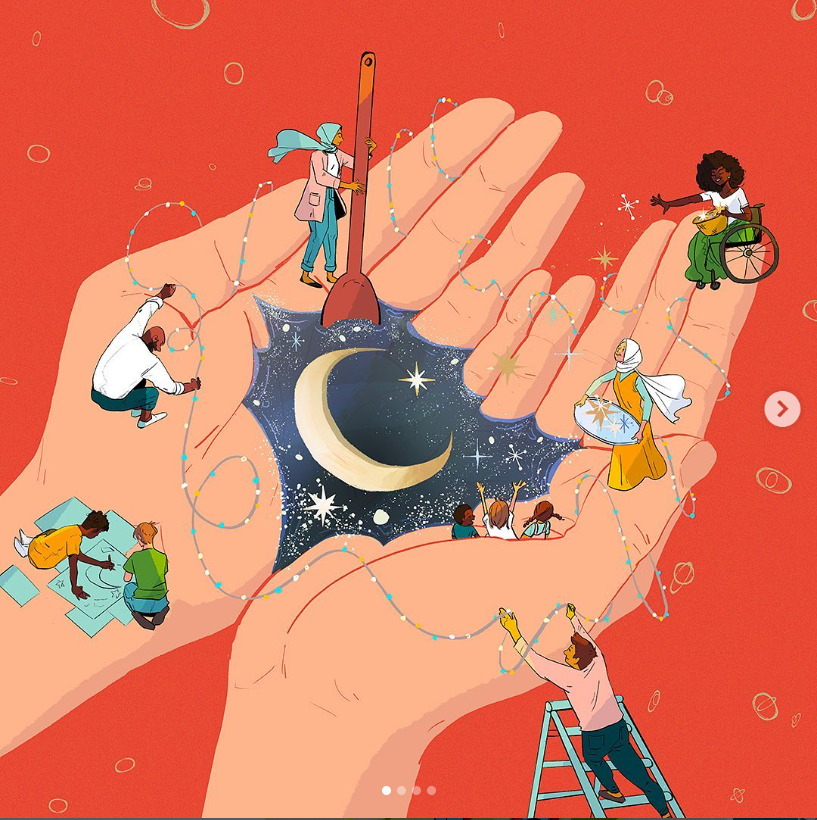
Self-love is intuitive
You were born, exactly as you were meant to be, free from insecurities and doubts. When you were a baby, if you were hungry, you never questioned whether you were worth feeding. When you wanted loving attention, you never questioned whether you were cute enough, or if you deserved it, or if you were being too demanding. And when you tried learning to do something new, you didn’t get embarrassed, call yourself an idiot, and give up after the first try. You simply tried again until you got it right. You were born knowing how to love yourself unconditionally.
Growing up, we experience things that teach us to believe that there are parts of us which are ‘wrong’, or ‘bad’, ‘unloveable’ or ‘unloved’. These emotional wounds, or ‘traumas’, are painful because they tell us that we need to change who we are, and how we act, in order to feel safe, loved and accepted. But the truth is, the more we try to change who we are out of fear and unworthiness, the more pain we feel.
“I reached a point where I never felt worse. Negative thoughts about myself playing in my head on a loop. It was like a prison. I could not accept myself. I felt unworthy and ashamed to turn to God. I kept thinking if I was stronger I wouldn’t be suffering. If only I knew then that my pain was self-inflicted. I was judging myself like I was my own worst enemy.”
Self-acceptance is self-knowledge
To love yourself, you must accept yourself. To accept yourself, you must get to know yourself. You are an expression of Divine love on this earth. You are an individual unlike anyone else who has ever, or ever will, exist. Every single thing you experience is an opportunity for you to manifest your qualities of love and compassion which were breathed into your soul by the One who is All-Loving and Compassionate.
Remember, you are capable of the most brilliant things, like: being able to love, perform acts of goodness, to learn, create art, choose your own path in life, and make your unique mark on the universe. A life of dignity, love, truth and beauty is your God-given birthright. Let this thought wash over you:
Right here, right now, in this reality, you matter to Allah – mind, body, and soul – exactly as you are.
Self-love is your soul’s surrender to peace
You may not have thought of it this way before, but in many ways, the strength of your self-love mirrors the health of your relationship with Allah.
“To me, self-love is faith. I don’t have the right to hate something Allah loves. That includes myself.”
Self-love means going through life feeling totally confident that your rights and dignity are non-negotiable, because Allah said so. Allah loves you, so you matter. And when your sense of worth comes directly from Allah, instead of what other people think of you, or the things that have happened to you, or the circumstances you are in now, the easier it is to trust in Allah’s plan for you.
So stop fighting against yourself and accept that you are good enough, just as the way you are.
“God is Al Wadud – the Loving, Ar Rahman – the Compassionate, Ar Raheem – the Merciful. I have to ask myself, am I embodying these qualities towards myself? If I’m not, then how can I start?”
“You can go on all the holidays, spa days and spiritual retreats in the world, but without self-love and trauma-healing, the high only lasts so long before you come crashing down.”
“Your life is not about tolerating pain, making yourself small, or being obedient to other people’s desires. Your life is about striving to live truthfully, and being the change you want to see in the world. If you don’t believe you’re worthy how are you going to do that?”
“You can only warn those who follow the Reminder and are in awe of the Most Compassionate unseen. So give them good news of forgiveness and a generous reward.” – Qur’an 36:11
Eight powerful ways to increase self-love and compassion
Some things are easier said than done. Let’s go through eight of the most important steps you need to master self-love:
- Challenge your inner critic
- Forgive your past mistakes
- Break free from people-pleasing
- Give up unhealthy comparison
- Stop chasing love
- Follow your heart
- Practice self-care (self-love in action)
- Invest in self-knowledge
1. Challenge your inner critic
“Truly! We created humankind in the most beautiful stature,” – Qur’an 95:4
It might sound weird, but have you ever spent time simply noticing your thoughts? What type of things do you tell yourself that don’t feel very kind or loving?
Writing a daily journal can really help you with this. Even just for a day or two, try jotting down a quick note each time you notice negative thoughts about yourself. But remember, this is not about judging yourself, just paying attention and noticing any patterns.
The more you observe your thoughts, the more you might notice that your negative thoughts sound a lot like the people in your life.
Your ‘inner-critic’ might sound just like a hard-to-please parent, an opinionated friend, or like the voices you’re hearing in the media.
Exercise: Understand your inner voice
- Am I polite or rude to myself?
- Do I speak to myself as kindly as I would to a friend who was struggling?
- How often in a day do I experience negative thoughts or feelings about myself?
- Do I accept these thoughts, try to ignore them, dwell on them, or try to fight them?
- Do I speak respectfully about myself to other people?
“Just because you think it, doesn’t mean you have to believe it. And if you believe it, it doesn’t necessarily mean it’s true.”
Exercise: Challenge your assumptions
Pick one or two negative opinions that really bug you. Try asking yourself:
- Are these opinions truly mine, or do they belong to someone else?
- Where/when did I learn to believe this point of view?
- Is there a kinder/alternative way of looking at this thing/situation?
- What advice would you give to your best friend if they were having these thoughts?
- Is there someone I trust who can share their point of view to help me see this differently?
2. Forgive your past mistakes
“Whoever does wrong, or wrongs themselves, but then seeks the forgiveness of God will find God forgiving and merciful.” – Qur’an 4:110
‘Self-criticism’ tells us we have a flaw, or we did something wrong.
‘Self-knowledge’ tells us why we have the flaw, or why we did that thing wrong.
‘Self-judgement’ tells us that because we are flawed and did things wrong, we are a ‘bad person’ and we deserve to suffer.
It’s self-love that permits us to welcome our flaws and errors like old friends, because they are teaching us beautiful lessons, making us stronger and wiser. It reminds us that we are not in fact on this earth to suffer, but to step from darkness into light.
Of course, not everything you do is wonderful. Striving to be the best version of yourself is an honourable and worthwhile pursuit which requires a lot of self-reflection and discipline. But it requires compassion, forgiveness and patience too.
“If you did not sin, God would replace you with people who would sin, and they would seek forgiveness from God, and God would forgive them.” – Prophet Muhammad (pbuh)
Suppressing or holding on to feelings of guilt, regret, embarrassment and shame, is only going to keep you stuck in cycles of negative behaviour and self-sabotage. This is what results in persistent feelings of low self-esteem, depression and anxiety.
Exercise: Forgive and let go – out loud!
Find a private space where you’re unlikely to be disturbed. Try looking in the mirror, or at a photo of yourself, and saying “I forgive you” and telling yourself all the things you most need to hear.
“I choose to hold on to the lessons, not the blame. Despair is not an option. I learnt this from Surah Qalam.”
“If God loves me, even with all my flaws, why shouldn’t I love me? If God can forgive, so must I.”
“When I look back and think ‘omg how was I so stupid?!’, I remind myself that back then I did what I could with what I had at the time. Me from the past did not know what today me knows now. And the fact that I can look back and see my mistakes is a sign of growth. Learning is a positive. The lessons were worth it. Who I am now is what counts. Alhamdulillah, always.”
“Why worry about not being perfect when even God expects you to make mistakes – you’re human! It’s about learning the lesson and trying again. If you’re paying attention, each lesson makes you stronger and a better person.”
“As long as there is breath in your body you have time to repent, make a change, ask forgiveness and turn over a new leaf. Life is about who you are now, in this moment, and what you will do. Not who you were then and what you did before you knew any better.”
If you’re having a hard time with self-forgiveness, or you’re struggling with a memory/memories that make you cringe, want to run away and hide, or provokes a strong physical or emotional reaction in you, it’s probably part of a deeper emotional wound that needs healing.
- Find out more about healing from trauma and abuse
- Read about repentance and forgiveness for your mental health
3. Break free from people-pleasing
“And he said, “Truly I am going to my Lord, He will guide me.”” – Qur’an 37:99
We can easily fall into the trap of thinking that pleasing others automatically equals pleasing Allah.
In your quest to be a good person, do you often sacrifice what makes you happy and fulfilled for the sake of others? Does doing what you actually want (instead of what you feel like you should do) make you worry about being too selfish, or mean, or even weak?
Surely, the point of any sacrifice in Islam is to make us grow into strong, empowered, dignified beings who live in contentment and spread light. If our sacrifices leave us feeling crushed, small, weak, rejected, insignificant or drained/burnt out, the chances are we need to look at what’s actually going on under the surface.
Not all sacrifice is noble. Good deeds don’t have to feel painful.
We grow up learning to seek approval from the people around us – that’s completely normal. It’s healthy to want to be liked and to have friends. Choosing to give your time and energy to someone as an act of kindness, is a beautiful thing!
But the important thing is to choose to act in a certain way because you truly want to, and not because deep-down you’re afraid of what will happen if you don’t, or just because you feel obliged. This is the difference between an empowered positive choice and a negative, disempowered choice.
Don’t give away your power
For example, you worry that your partner might stop liking you, so you keep saying ‘yes’ to them, even though you really want to say ‘no’. Or, you’re always afraid to tell your friends your real opinions, because you think they’ll get upset, and so you never express yourself truthfully, making you feel trapped and depressed.
Remember, you are only responsible for your actions and intentions. You have no power to control how someone reacts to you – and it’s not your place to either. Uncomfortable feelings are not wrong, or bad – they are a necessary part of life. People should be allowed to feel them. So let them.
“Learning to say no and create boundaries was HARD. The people I spent my life trying not to upset were the people who got the most upset when I started saying no, and speaking my mind. Isn’t that ironic. I supported them, but they did not want to support me.”
“If you think you’re a kind and honest person, but you only do what pleases other people, you’re not that honest and you’re not that kind.”
Exercise: Questions if you think you may be people-pleasing
- Am I being treated with respect in this situation?
- Am I treating myself with respect in this situation?
- How am I holding myself back? If there were no possible bad consequences, what would I be doing or saying?
- Which of my values am I upholding? Which of my values am I ignoring? (Love, truth, justice, peace etc).
- What advice would I give someone I love if they were in my situation?
- Have I voiced my needs and point of view clearly so that the other person has a chance to genuinely understand how I feel about this?
4. Give up unhealthy comparison
“O humankind! We have made you…into nations and tribes, so that you may get to know one another. The noblest of you in God’s sight is the one who is most righteous.” — Qur’an 49:13
You are a beautiful soul, full of strengths, experiencing life in your unique and sensitive body.
No one in this world can compare to you, because no one else is you!
You’ll always find people who have more than you, and people with less than you. Life is about taking what you have, and doing your best with it. While you can’t control some things, you can choose your perspective. So give yourself permission to acknowledge and appreciate what you like about yourself.

Only God can judge us
“And do not invoke another god with Allah; there is no god except He. All things perish, except His Face. To Him belongs the Judgment, and to Him you will be returned.” — Qur’an 28:88
Remember, whenever we act as though our own, or somebody else’s, view of us, is the undeniable truth – on whether we’re good/bad, important/insignificant, beautiful/ugly, success/failure – we place our trust in our ego instead of Allah. This is a fast train to dissatisfaction. We all do this from time to time, the important thing is to notice when it happens to that we can let these feelings of judgment go.
One of the best antidotes to unhealthy comparison and self-criticism is gratitude.
Set yourself free
“Self-criticism and worrying about people’s opinions is literally like putting yourself in prison and being your own jailer.”
“An orange tree doesn’t get sad because it can’t produce olives. And an olive tree has no idea how to make oranges. You get what you’re given and that’s ok. The world is better because all the trees make different fruits. If you’re an orange, don’t change for the people who prefer olives – just find the crowd who appreciate you for you!”
“Fear of what other people might think stopped me doing the simplest things – like leaving my house without lots of makeup, speaking my mind at work, and truly being myself around friends and partners. I look back and think how I wasted some of the best opportunities because I was dedicated to my negative beliefs. Thankfully, it’s never too late to learn. When you finally learn, better opportunities arise, inshallah.”
“My mind was a constant stream of ‘I’m not as funny, not as rich, not as devout, too stupid, too fat, too nerdy…’ These types of thoughts are literally the devil. And they all boil down to just one uber-thought: ‘I am not good enough’. But it’s a lie. Good enough for who? Stop being hard on yourself. You are plenty good enough.”
5. Stop chasing love
“I am worthy of love. I don’t need a ‘because’ on the end of that sentence. And I don’t need to justify why – I just am.”
Love can feel difficult, like something you need to find, or continuously earn. But you don’t need to fit into someone else’s image of perfection to be loved, or loveable. Love isn’t a mystery – it actually shows up in our lives in hundreds of new ways each day. We can be so fixated on a particular vision of love that this is sometimes hard to see.
“I killed a potentially good relationship by always doing what I thought my partner wanted. I was overthinking every move and scared of rejection. I spent more time wondering what they thought of me, than what I felt about them. I was so desperate for love that I kinda lost myself. I should have just done what I wanted and not been scared of their reaction.”
There is nothing wrong with looking for love, or wanting to be in a healthy relationship. But relying on other people to validate you, or making it your partner’s responsibility to make you feel good about yourself, is not going to work in the long-term.
You are allowed to tell people how you want them to express their love to you, and its ok to walk away from people who cannot, or do not want to, meet your needs.
“Your ability to give and receive love is not defined by your relationship status, or the number of friends you hang out with.”
- Find out more about trauma-healing to let go of difficult experiences that made you feel unworthy, damaged, or ‘not enough’ to be loved.
6. Access your intuition
“So hold fast to that which We have inspired in you. Truly you are on a straight path… But when he brought them Our signs, behold, they laughed at them.” – Qur’an 12:76
There is a voice inside you that calls on you to be true to yourself – even if the rest of the world thinks you’re crazy, or your ego is chasing after worldly gain. This is the language of the heart, or intuition. When you fight against your true feelings, you’re going to feel worse.
“…Respond to the caller of Allah and believe in him…” Quran 46:31
Your heart’s language isn’t words, but feelings, instincts, yearnings, gratitude, relief, kindness, vibes, and that feeling when for some unexplained reason you ‘just know.’ It is the voice that speaks to you with pure, unconditional love – wanting only what is best for you, to bring you deeper into Divine love, truth and mercy. Your heart will never tell you that you’re not good enough.
“People say follow your heart for a reason. Your brain is complicated and capable of lying. Your heart exists simply to keep you alive. Think about that. Your heart’s sole purpose is your wellbeing!”
“When a thing disturbs the peace of your heart, give it up.” – Prophet Muhammad (pbuh)
Spirituality nourishes intuition
The more you nurture and nourish your spirituality and connection to Allah, the easier it becomes to distinguish what your heart is telling you from the many other voices around you. Regular prayer, reflecting on the Qur’an and increasing your dhikr are powerful filters for your heart.
But remember, if you have been through lots of trauma or abuse, you may also need a lot of self-care, plus professional support, to help you feel safe tapping into your intuition.
“There is no doubt that hearts becomes rusty just as copper and silver coins become rusty. The polish for this is dhikr (the remembrance of Allah). This is because dhikr is like a polish [which polishes the heart] like a shiny mirror. When dhikr is left, the rust returns. But when dhikr resumes, then the heart is polished again.” – Prophet Muhammad (pbuh)
- If you want to strengthen your intuition read our helpful guide on how to access your intuition.
- We also have a guide to help you with dhikr and meditation to clear your heart from blocks and rust.
7. Practice self-care (self-love in action)
“And trust in the Mighty, the Merciful.” – Qur’an 26:217
Self-care means acting in a way that is consistent with loving yourself. That means looking after your basic needs – physical, mental, social, emotional, and spiritual.
It’s time to focus on your needs by doing things specifically for your own health, mental health, enjoyment, self-development, comfort and fun!
When what you want conflicts with what you think you should want, or with feelings of responsibility towards people you care about, or towards God, suddenly self-care can seem impractical.
Is it really possible to do as we please, follow our dreams, let people down, and still be good Muslims? The answer is yes! Find out how by reading your full self-care guide.
“If you’re on the fence about doing something just for you and your own mental wellbeing, why hesitate? You’re worth it.”
8. Invest in self-knowledge
“We raise in degrees whomsoever We will, and above every possessor of knowledge is one more knowing.” – Qur’an 12:76
Time and money spent on getting to know yourself better is always an investment. Remember, you can’t ‘buy’ good mental health, but the more time you invest in understanding yourself, the better you will handle relationships, work, and life’s ups and downs.
Of course, you can only do as much as is practical within your individual circumstances – but something is always better than nothing.
Invest in yourself
The longest relationship you’ll ever have in life is with you – so invest in yourself! Here are some things that might help:
- Consider joining a local library
- Ask friends about books/podcasts that helped them see the world differently
- Listen to something that interests you for five minutes on your commute to work/school
- Follow social media accounts that help you learn and grow and make the most of YouTube
- Take a look at the mental health resources page for helpful accounts and videos
Useful resources to help boost self-love and mental wellbeing:
- Learn about trauma healing – important for everybody who finds self-love difficult, especially if you have experienced any form of abuse or mistreatment
- Is therapy or counselling good for Muslims? Thoughts on navigating mental health support as a Muslim living in a non-Muslim context
- How to have honest conversations about your mental health with someone you trust – for anyone struggling to open up
- How to practice dhikr and meditation to support your wellbeing – amazing if you struggle to feel peaceful, are going through a lot, are under stress or you’re struggling to make sense of your life/identity
- Prayer and mental health – help (re)build your connection with prayer
- A guide to explore your spirituality – get to know yourself on a deeper level and find purpose, meaning and fulfilment
- How to inspire stronger feelings of gratitude – especially helpful if you struggle with a harsh inner-critic, feelings of hopelessness, anxiety, or low mood
- Guide to finding your path – for anyone looking for motivation, or feeling lost, confused and uncertain about the future
Whatever you are going through right now, you can get through it – and you deserve all the love in the world.